Showing posts with label cat team. Show all posts

Saturday, October 24, 2009

The first hard Learning of the Cats

This post begins a journey of unpredictable length which describes things the Lean and Mean Cat Team has learned along the way towards achieving significance within the games market. We will begin with the hardest lesson first, then possibly move on to easier ones later.

A hard lesson for Expert Cat: Mastering Perspective
This is a lesson about communication and understanding where one of the biggest risks with your product really lies. Expert Cat has gone through a life long journey to develop an understanding for this type of situation so it will not be a nice and easy lesson to describe. But we shall give it a try, Expert cat is whispering his s33kritz into my ear as I try to write them down.
This is what Expert Cat looks like as he is trying to convey this message for me to write down.
As you can see he is sitting next to little blue dots and lines which say Node, Link and System. This might not seem like something which is a learning, but it is a pillar of the most fundamental learning he wants to tell you about.
He says that in the beginning he thought about the world as if it was made out of Nodes. That means things which has properties in themselves. It is an effective way of observing things to treat them as nodes and it makes life for the Expert Cat easier on the surface. He can describe them and point at them and people who listen to him has a decent chance to understand what he is talking about.
Links are a bit trickier to understand. They are the connections between nodes which describe that the nodes are interacting with each other somehow. This is a lot harder for Expert Cat to at first understand, even harder to make use of and almost hopeless to describe. How do you describe that the car and the road are connected through a link, you cant see it? Maybe the tires are a link, maybe it is the driver which wants to travel who is the link or maybe it is the engine which make the tires turn with force. Expert Cat almost goes crazy trying to describe this to other cats.
Systems are a bit easier to describe but harder to create. Expert Cat can lump a car, a road, an engine and a driver into a clump of things which together are a system. When he describes the whole system to other cats they intuitively understand that they could make some use out of the ability to drive along roads to places at speed and derive some type of value out of it.

When Expert Cat was young
As a youngster Expert Cat wanted to do great things for the other cats in the world and began working on creating things. Since back then he was only really able to understand the concept of Nodes he went about and made things. Sometimes his things caught a litle bit of interest among the other cats but nothing really worked. What is wrong with my things? - he though a bit sadly.
No one really wants things it seems. Well, actually there are situations where thing are wanted but those are special cases which Expert Cat will tell us about later in this story.

Expert Cat is trained by Master Cat
After making a series of failed things Expert Cat went out looking for a Master Cat who would become a great teacher. Master Cat began training Expert Cat at using different perspectives of looking at the world and introduced Expert Cat to the idea of systems. The things Expert Cat had been making were failing because they were not part of a system which the other cats were part of. The things which had partial success had by a chance become adopted by other cats as pieces of their personal systems which are hidden in the mystery of cat souls.
Master Cat spent years and years and mentored Expert Cat to learn how to observe systems. About ten years after meeting with Master Cat our Expert Cat emerged as a fully trained systems observer.

A trained Expert Cat
To make things successfully our Expert Cat learned to create links. Sometimes links demand the creation of Nodes, and sometimes links demand other things. The core understanding of Expert Cat was to see that things without links are dead weight, waste and useless creations in general.
The next problem for Expert Cat is to describe what a link is. This is a fundamentally tricky problem because they are always different in detail but similar in the abstract. Since the details always differ we can make one detailed example and try to move onwards from there.

Details of a Link
Lets us begin describing a link. We will describe the link of Eating. We can look at something and notice that it is getting Eaten. A good start. Expert Cat wants to create the link of Eating.
To create the link of Eating our Expert Cat needs to become dependant on two nodes. One node is a Cat, who Expert Cat thinks will be interested in eating. The second node is a Fish which Expert Cat thinks has suitable fit for the occasion.
This is a deep understanding of the Expert Cat. The value in the system of "Cat eats Fish" lies within the interactive process which is commonly called eating. The value of the fish which is not eaten can be considered "inventory" which according to lean is a risk. From now on when Expert Cat make things he defines his thing as the interaction between the nodes in the system. The ten years of training which Expert Cat has contained a few weeks of trying to understand the writings of Guru Cat Chris Crawford who says the trick to creating games lies with defining the design from the verbs in the design. Expert Cat believes this argument says the same thing with different words. Expert Cat believe verbs are quite useful when defining links.

Creating systems through Links, Nodes or Systems
While training with Master Cat our Expert Cat learned a few other things about systems. Different types of systems require different approaches towards their creation. To avoid needing to write far too much text we will narrow the problem down to two extremes.
The two extremes are described by a Guru Cat called Steve Blank. He uses a model which is a useful framework to dig at this problem. He uses the words "Customer Risk" on one end and "Technology Risk" on the other. Then there are things which has both...
On one extreme end we have a system where the risk is the functionality within the nodes. At this extreme end we find things such as a Fusion Reactor. If you can get the Fusion Reactor to work as it should then you have your value right there. Infinite power for a low cost. We can define this value as its node. If it works it will also have value for the other cats in the world.
On the other extreme we have the taste of Fish. Does the taste of the fish which Expert Cat is creating have any value on the market? The risk here is not that the Fish has a taste, or even if the fish exist, but rather if the taste causes the cat to eat. How does the cat eat the fish? Oh noez! This is so complicated Expert Cat is almost trembling at the notion of describing the situation.

To describe the problematic description as hypothesis
We need to use another lens to look at the problem to get a perspective which has a better chance of succeeding. To create the correct taste when cooking the fish our Expert Cat creates a hypothesis that says: "The fish tastes good enough to make another cat eat it." This puts the link to the test!
Now our Expert Cat can cook the fish with an inventive recipe and try to make another cat eat it. He can modulate his test and see if he can make another cat pay for the cooked fish, and see which of all the cats are willing to eat it or not eat it.
By successfully describing his fish recipe as the properties of eating he has obtained the all powerful insight into how changes to the recipe influence the value of the system. Wewt!

Ok, so what does this mean in practice?
Our Expert Cat understands how to differentiate customer risk versus technology risk. When Expert Cat joins a Mean and Lean Cat Team he knows that his team will be more or less suitable to handle the different types of risks. A team full of scientist and engineering wizard cats is likely to be suitable for taking on technical risk, which a team full of marketing Fixers and emotional Artist cats is suitable for taking on customer risk. A team which has a healthy balance of both is likely to take on challenges which contain both types of risk.

Kinds of risks for game creating cat teams
This is a pretty big system which practically is rather simple to understand.
Games with some Technical Risk:
  • MMORPG's
  • Next Gen AAA Console Games
Games with Customer Risk (Everything else):
  • Flash Games
  • Web based community Games
  • Facebook Games
  • Marketing Campaign Games
  • Indie Console Games
  • Indie PC Games
  • Oldskool Games
  • etc
Note that no games that the Expert Cat think is a game has purely Technical Risk. Defining a game Hypothesis as Nodes is thereby almost a guaranteed failure. Alright, Expert Cat jumped over a long series of arguments to reach that conclusion, but his time is running out and he wants to get out of here rather than keep on telling us the details of this story.
Farewell Expert cat, enjoy the sunshine and the Fish cooking! *waves*

Fixer Cat comes in to finish the lesson and says:
- Lean and Mean Cat Teams that use Agile or Scrum to create games need to learn how to define their Backlogs as links. If they fail to do this and instead base their work on creating nodes they become statistical death marches. However, if you create an MMORPG or a Next Gen AAA Console Title you can use a bit of both nodes and links to deal with technical risk.

Thursday, October 15, 2009

The complete cat strategy guide for game production

This is a story about a group of agile cats with skills and a passion for games who build a game together. They met somewhere and founded:
pic
One Lean and Mean cat machine which will be doing something cool and have an awesomely good time together while doing it. The cat team introduces themselves and writes witty descriptions about what they do on their Google Wave.
Fixer Cat: "I am like doing all that stuff that no one else does, making sure that nothing stops the other cats from doing awesome stuff. I am obsessive about development process, cycle time, kaizen, integrity and communication. Other IT projects might call me a combination of QA, Operations and maybe Producer."
Artist Cat: "Art is like a universe of symbolic language which has emotional resonance and communicate directly into the users brain through traditional data generation. I paint, I make sounds, I write texts, I make landscapes, labyrinths, hats, mice, animations, music, particles, movies and everything that you see and hear within the game. I got quite the education to know the theory, tools and practices of all these spiffy art forms."
Wizzard Cat: "Computers speak directly to my soul. Little impulses of electricity becomes living worlds full of cats and mice through the magic I perform. You might think the world is made out of things, I know it is made out of math, logic and process. Nothing within the game reaches the player unless I make it work. All the programming languages, technical platforms, rendering engines, deployment process, automated testing and the lot is stuff I have mastered. I am quite awesome."
Expert Cat: "Sun Tzu would be pwnd by me. If he wasn't dead already, I am still alive. I know marketing and how to position products. I know how to measure success and set goals which will be even more successful. I speak directly to the end users and learn what they desire. I communicate the markets desires to the team and workshop with the team until they prove they understand what the market wants. I test the products on the market and improve our results relentlessly. A game developer would call me a designer, maybe a non-traditional artist or a biz analyst. I also do stuff like interaction design and scripting when needed."
Our four cats are maybe not using the most conventional titles as the ones you might be familiar with. But keep in mind that these guys are mean and lean cats. They don't follow conventional rules. They make their own rules and play their own game to win.

pic
Two kinds of players here, you know them already... In the world of cats they dont know they are a market. They just want to live their lives happily and in peace.

alternative text
The cats start working on a vision which causes a lot of half friendly cat fighting, including hissing and big fuzzy tails. Eventually cool cats reach agreement and begin with reality checking what they agreed upon. They keep running around in this loop until reality align with their concept. Or maybe it is the other way around, its difficult sometimes. If they fail they go back to the vision but these cats are so mean they only fail about half the time.

alternative text
The cat team takes a close look at the vision and how it is positioned on the market. They don't want to run into those nasty big competitors, some smaller competitors are quite ok however. They know what they are doing so they pick a spot which looks like it might have a few lonely cats without suitable and good games to play.

alternative text
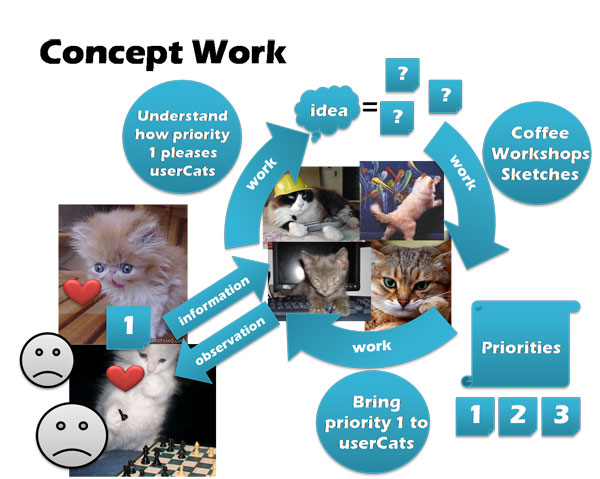
Since the cat team has found its market position for a game they can start hammering out the concept. What kind of thing is this game that these other userCats are likely to want? They figure out what kind of symbolism might stimulate this audience into taking action. What kinds of goals the userCats are likely to find engaging. And they put these things into a list of priorities for production.
With priorities sitting on the wall as post-it notes they take the first one and they go out on the streets where userCats are hanging around waiting to be entertained. They talk to the userCats and carefully nudge up some information about the highest priority. Woot! This works! UserCats like this type of stuff... well sometimes at least. Quite often they have to run this loop a few times before userCats seem to provide the correct information. They might also learn new things about the competition here which needs to be taken into consideration. Sometimes they even encounter the wrong userCats and have to change them for others.

pic
With a successfully developed list of priorities the cat team starts producing prototype products. They think this is what a Minimum Viable Product is about. They bring it to the userCats and see what happens when the user cats try it. In the beginning it does not work very good, but the mean and lean cat team knows how to repair their broken prototype and after a while the userCats start to appear rather engaged when testing it.
And there it is! The cat team has found resonance after a few attempts of prototyping. This is a key moment for the team to get a morale boost which will bring them forward towards cat nirvana.

alternative text
With the successful prototype to guide them the cat team goes into production.since they are so lean and mean they don't need any more cats for this, all they need is an even tighter relationship with the end userCats. So they pull userCats really close to the team to make sure they can test their product continuously against a useful feedback pipeline.
At this point the team starts investing a significant portion of their time into making sure that they can keep up a high speed through the loop. A lean and mean cat machine knows that the most important thing is to be able to react to feedback as fast as possible and they keep on making their reactions faster and faster for every circuit through the loop. The Wizzard protests loudly when the magic might be going kaboom in the future and the Expert stops the production and does a "5 whys" if the feedback from the userCats starts sounding like strange noises.

pic

While running through the production loop the cat team is making these userCat loops, Daniel Cook named them STARS. Each feature consist of many of these loops and each iteration the cat team add value to these loops. Stimuli is the first thing the userCats encounter. The team makes sure all the stimuli in the game makes sense and fits the expectations of the userCats and sometimes they make sure that the userCats are positively surprised when moving through the STARS loop.
Daniel Cook is a hero for lean and mean cat teams.

pic

Eventually the cat team will be successfully stringing the userCat loops together in some awesome patterns. As the Newbie user cat successfully runs through the loops the Newbie cat gets more and more engaged. The cat team is so good at this that the loops are whole and working. UserCats experience good pleasure and they don't burn out or feel confused and annoyed. As a userCat plays the first finished parts of the game it feels showers of dopamine in its brain which are produced when the nerve system extends its associations to better handle the Skills required by the game.

pic
When the cat team picks up a new piece of the game to build they know that they are only in the beginning of a journey which will need a few round trips with the same piece. They are quite competent so they understand that trying to add another piece before the current one reaches the "market demand per feature threshold" is going to lead to a ton of waste in future production.
While working on making one function in the game good they methodically monitor the feedback from userCats for each iteration. They keep on iterating until there is statistically reliable proof that the purring is caused by the product and not something else.

alternative text

Oh noez! The cat team has run into a road block!
Regardless of how many times they iterate on a piece of the concept which aim towards the vision they just can't make the userCat purr from it. This is a tough spot to be in. Now they have to do a pivot. Such a lean and mean cat team is not very scared of this problem. They know that they have a solid core product developed which causes userCats to purr satisfyingly. To keep on progressing their product so they can get even more purring all they need to do is some analysis and observation.
The cat team steps back a bit and takes a close look at the market again. "Ok" they say, lets figure out where to move now. Should they abandon the project? Switch to some totally brand spanking new vision? Or ignore the feedback and release it anyway? No, instead they keep one paw firmly planted in their current vision, and prepare to take a step towards a new direction.
They adjust the aim of the vision a bit, keep the successfully developed userCat value, kill the remainder of the old backlog and define a new set of concept pieces which will lead to the new visionary point they find interesting.
pic

Eventually the game does all of the things it should be doing and the userCats are excitedly running along its dopamine infused feedback loops, having a blast and feeling the luurve all around. The userCats realize that the lean and mean cat team made something that was just perfect for them and they send love letters and even a bit of money to the cat team.
The Cat Team are heroes in the world of the userCats and they know it. What the cat team will be doing next is a secret hidden within the future.

pic